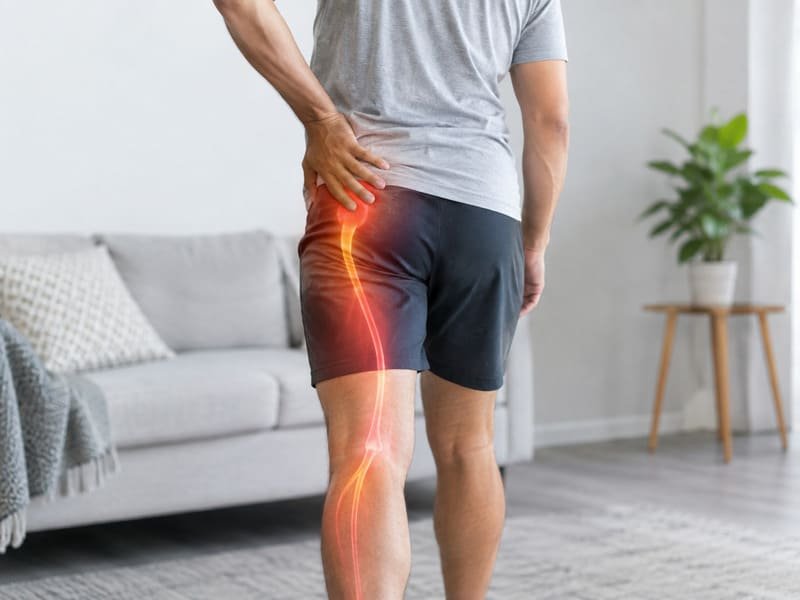
Sciatica is pain that travels along the path of the sciatic nerve, usually from the lower back or buttock into the leg.
The medical term lumbar radiculopathy refers to irritation or compression of a nerve root in the lower spine.
When one of these nerves becomes irritated, symptoms can travel away from the spine and into the: buttock; hip; thigh; calf; foot.
Sciatica describes a pattern of leg pain rather than a disease by itself. It most often comes from irritation of a nerve root in the lower spine. [1]
What Does Sciatica Feel Like
Sciatica often feels different from ordinary low back pain.
Common symptoms include: sharp or shooting pain; burning pain; electric or shock-like pain; tingling; pins and needles; numbness; leg weakness; pain traveling from the back or buttock into the leg.
Symptoms commonly affect one side of the body, although both legs can sometimes be involved.
Pain may become worse with: prolonged sitting; bending; lifting; coughing; sneezing; certain twisting movements.
Some people have significant leg pain with only mild back pain. [1]
Sciatica and Low Back Pain
Low back pain does not automatically mean someone has sciatica.
Low back pain may stay primarily in the back.
Sciatica or lumbar radiculopathy usually involves symptoms that travel into the buttock or leg because a spinal nerve is irritated.
The pain may follow the pathway of a particular nerve root. [1]
What Causes Sciatica
Several conditions can irritate or compress a nerve in the lower spine.
Common causes include: herniated disc; degenerative disc changes; spinal stenosis; bone spurs; arthritis of the spine; spondylolisthesis; narrowing around the spinal nerve roots.
Less commonly, symptoms may result from trauma, infection, tumors, or other medical conditions. [1]
Herniated Disc
The discs between the bones of the spine act as cushions.
A disc can sometimes bulge or herniate and place pressure on a nearby nerve root.
This can cause: leg pain; tingling; numbness; weakness.
Not every disc herniation causes symptoms.
Many people have disc changes on imaging without having pain. [1]
Spinal Stenosis
Spinal stenosis means narrowing of the spaces around the nerves in the spine.
Lumbar spinal stenosis can cause: low back pain; leg pain; tingling; weakness; heaviness in the legs.
Some people notice that symptoms become worse with prolonged standing or walking and improve when sitting or leaning forward. [1]
How Is Sciatica Evaluated
A healthcare professional will usually ask about: where the pain begins; where it travels; what the pain feels like; numbness or tingling; weakness; changes in walking; symptoms that make pain better or worse; bladder or bowel symptoms; previous injuries; previous back problems.
A physical examination may evaluate: strength; sensation; reflexes; walking; range of motion; leg symptoms with certain movements.
Certain examination techniques may help determine whether a spinal nerve is irritated. [1]
Do You Always Need an MRI
Not everyone with sciatica needs immediate imaging.
Many episodes of lumbar radiculopathy improve with time and conservative treatment.
A healthcare professional may consider imaging such as MRI when: symptoms are severe or worsening; significant weakness is present; symptoms continue despite appropriate treatment; surgery or another procedure is being considered; red-flag symptoms are present; another serious condition is suspected.
Imaging findings should always be interpreted together with symptoms and physical examination findings. [2]
What Can Help Sciatica
Most people begin with conservative treatment unless there are signs of a serious neurological problem.
Treatment may include: staying appropriately active; exercise; physical therapy; activity modification; heat or cold; non-opioid medications when appropriate; gradual return to normal activities.
The best treatment depends on the cause and severity of symptoms. [1]
Keep Moving
Prolonged bed rest is generally not recommended for routine sciatica.
Gentle movement can help maintain: strength; flexibility; circulation; confidence with movement.
Walking and other low-impact activities may be helpful if tolerated.
During a severe flare, activity may need to be temporarily modified.
The goal is usually to gradually return to normal movement rather than completely avoiding activity. [1]
Physical Therapy
Physical therapy can help address: mobility; strength; core stability; flexibility; posture; body mechanics; walking; return to activity.
A physical therapist may provide exercises designed around the pattern of nerve irritation and the person’s functional limitations. [1]
Exercise
Exercise may include: walking; gentle stretching; core stabilization; hip strengthening; back-strengthening exercises; mobility exercises; aerobic conditioning.
There is no single exercise program that is appropriate for everyone with sciatica.
Exercises should be individualized based on symptoms and medical conditions. [1]
Heat and Cold
Some people find temporary relief with heat or cold. [1]
Heat
Heat may help: relax tight muscles; reduce stiffness; make gentle movement easier. [1]
Cold
Cold may temporarily reduce discomfort after certain activities or during acute pain flare-ups.
Protect the skin when using heat or cold treatments. [1]
What About Medication
NSAIDs have limited evidence of benefit for sciatica and can cause harm. Ask your clinician about your medical conditions and medication interactions. NICE advises against oral corticosteroids and benzodiazepines for sciatica. [2]
What About Gabapentin or Pregabalin
NICE advises against gabapentin and pregabalin for sciatica because overall benefit has not been shown and harms can occur. They may help other nerve pain conditions. If already prescribed, discuss a review and any gradual reduction with your prescriber. [2]
Epidural Steroid Injections
For selected patients with significant radicular pain, a healthcare professional may consider an epidural steroid injection.
The goal is usually to: reduce inflammation around the irritated nerve; provide temporary pain relief; improve participation in rehabilitation.
Relief varies from person to person.
An injection does not necessarily correct the underlying structural problem.
Patients should discuss the potential benefits, limitations, and risks with their healthcare professional. [1] [2]
When Is Surgery Considered
Most cases of sciatica do not require surgery.
Surgery may be considered when a person has: severe persistent symptoms; progressive weakness; significant neurological deficits; symptoms that substantially limit function; persistent pain despite appropriate conservative treatment.
Emergency surgery may be necessary in rare situations involving severe nerve compression. [2] [3]
What About Opioids
NICE recommends against opioids for chronic sciatica. Other circumstances require an individual assessment.
Treatment usually focuses on: staying active; physical therapy; exercise; appropriate non-opioid medications; treating the underlying cause when necessary.
Opioids carry risks including: sedation; constipation; falls; physical dependence; opioid use disorder; respiratory depression; overdose.
If opioids are considered, the potential benefits and risks should be carefully evaluated.
If you already take an opioid regularly, discuss any reduction with your prescriber; do not stop it suddenly on your own. [2] [4]
Focus on Function
Treatment success should not be measured only by the pain number.
Consider whether you are able to: walk farther; sit more comfortably; sleep better; return to work; perform household activities; exercise; climb stairs; drive; participate in rehabilitation.
Functional improvement can be an important sign that the treatment plan is helping.
Questions to Ask Your Healthcare Professional
Consider asking:
- Is my leg pain likely coming from a spinal nerve?
- Do I need an MRI?
- What activities are safe for me?
- Would physical therapy help?
- What exercises should I perform?
- Are any medications appropriate for nerve pain?
- Would an injection be helpful?
- What symptoms should make me seek urgent medical care?
- When should I see a spine specialist?
- What functional goals should I work toward?
When Should You Seek Urgent Medical Attention
Most sciatica is not an emergency.
However, certain symptoms may indicate severe nerve compression or another serious condition.
Seek prompt medical attention if you develop:
- New or rapidly worsening leg weakness
- Difficulty walking because of weakness
- Severe or progressive numbness
Go to an emergency department now if you develop:
- New loss of bladder control
- New loss of bowel control
- Difficulty starting urination or inability to urinate
- Numbness around the groin, genital area, buttocks, or inner thighs
- Severe weakness affecting both legs
- Rapidly worsening neurological symptoms
These symptoms may suggest cauda equina syndrome, a rare but serious condition requiring emergency evaluation.
Also seek prompt evaluation if back or leg pain occurs with:
- Fever
- Chills
- Significant recent trauma
- History of cancer
- Unexplained weight loss
- Serious infection risk
- Severe pain that is rapidly worsening [3]
Living Well With Sciatica
Sciatica can be painful and frightening, particularly when pain travels into the leg or causes numbness.
However, many cases improve with time and appropriate conservative management.
Recovery often involves: staying appropriately active; gradually returning to normal movement; strengthening the muscles that support the spine; managing sleep; using medications safely when needed; participating in rehabilitation; monitoring neurological symptoms.
Fear of pain can sometimes lead people to avoid movement completely.
While certain activities may need temporary modification, gradual movement is often an important part of recovery.
Instead of asking only:
“Is my pain completely gone?”
also consider:
“Am I walking better, moving more confidently, and returning to the activities that matter to me?”
Those functional improvements are meaningful signs of progress.